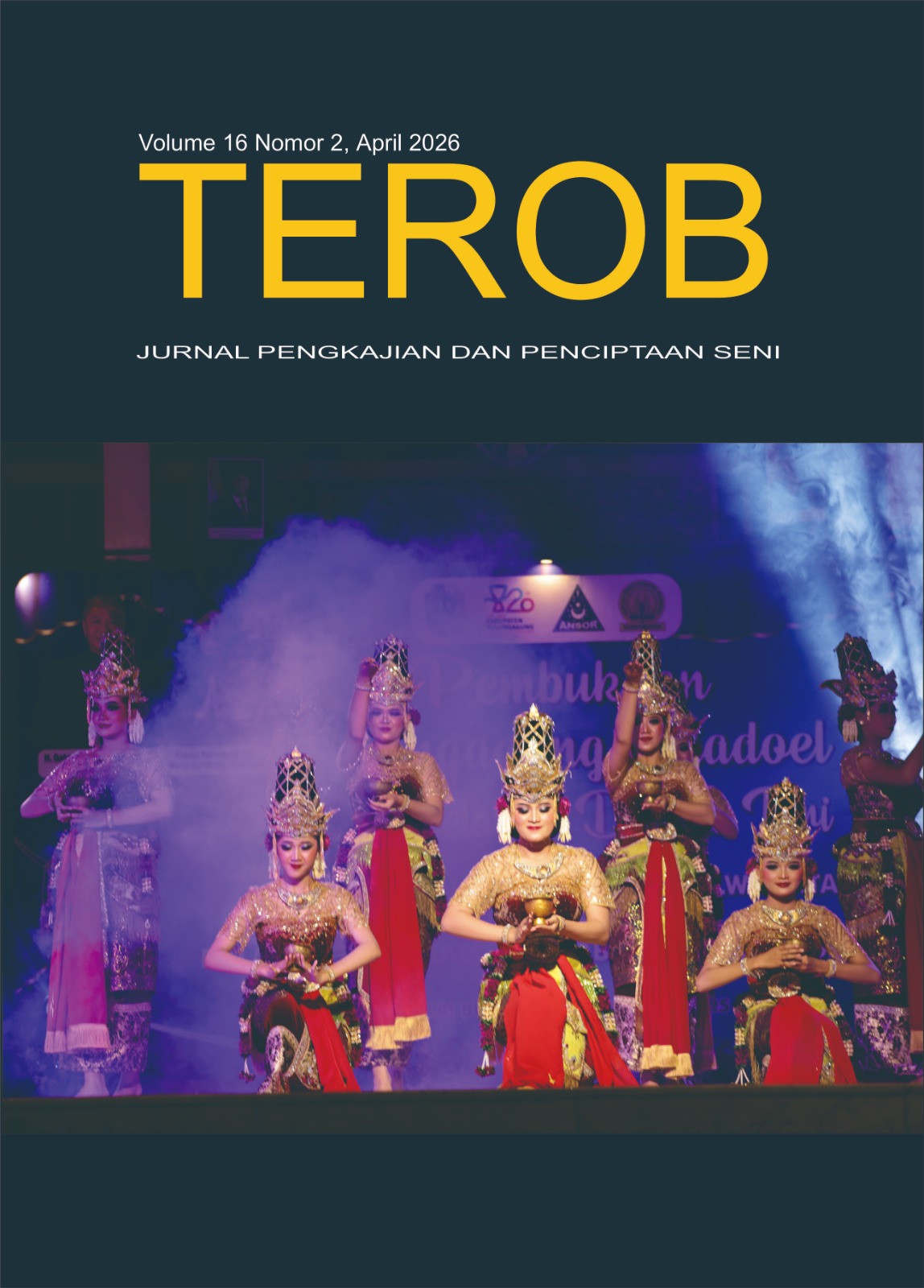
The Conservation of The Oklik Performance Within The Bersih Desa Ritual Tradition in Sobontoro Village, Balen District, Bojonegoro Regency
DOI:
https://doi.org/10.20111/terob.v16i2.124Keywords:
Conservation, Oklik Performance, Traditional Ritual, Bersih Desa, Sobontoro VillageAbstract
This study investigates the conservation of the Oklik performance as an integral component of the Bersih Desa traditional ritual in Sobontoro Village, Balen District, Bojonegoro Regency. The research focuses on the structural characteristics of the performance, its socio-cultural functions, conservation strategies, and the impacts generated by preservation efforts of this agrarian ritual art. The study addresses key questions concerning the role of the Oklik performance within the Bersih Desa ritual and the implications of its conservation for the local community. Research participants included Oklik performers, traditional leaders, village officials, and members of the younger generation in Sobontoro Village. A qualitative methodology employing an ethnographic approach was applied through participant observation, in-depth interviews, and documentation. Data were analyzed descriptively and interpretively, with particular attention to ritual functions, symbolic meanings, sacred values, and conservation outcomes. The findings reveal that the Oklik performance functions as a ritual medium, a form of communal entertainment, and a mechanism for reinforcing social cohesion within the community. Academically, this study contributes a conceptual model for the conservation of ritual-based traditional arts that may be adapted to other cultural contexts. From a socio-cultural perspective, the conservation of Oklik strengthens local cultural identity, facilitates the regeneration of young artists, and revitalizes values of mutual cooperation and harmony among humans, nature, and spirituality. Economically, the conservation efforts stimulate the development of micro, small, and medium enterprises (MSMEs) rooted in traditional rituals and enhance the potential for cultural tourism without compromising the ritual’s sacred character. Additionally, the study demonstrates educational implications through the incorporation of Oklik into local arts and culture curricula and provides a reference for local government policies concerning the safeguarding of intangible cultural heritage. In conclusion, the conservation of the Oklik performance generates measurable and sustainable impacts on cultural preservation, community empowerment, and regional cultural development.
References
Moleong, L. J. (2002). Metodologi Penelitian Kualitatif, Bandung: Rosdakarya. Linda Herawati Gunawan, Dkk.(2015), Terapi Autisma Dengan Metode Picture Exchange Communication System, Jakarta: Leutika Prio.
INTERVIEW
Kadarminto. (2025, Desember 13). Penelitian Oklik Desa Sobontoro, Bojonegoro. (L. Lestari, Interviewer)
Mursim, K. (2025, September 20). Penelitian Oklik Desa Sobonroto, Bojonegoro. (L. Lestari, Interviewer)
Sukri. (2025, Juli 15). Penelitian Oklik Desa Sobontoro, Bojonegoro. (Lilis, Interviewer)
Suyanto. (2025, Agustus 28). Penelitian Oklik Desa Sobontoro, Bojonegoro. (L. Lestari, Interviewer)
Downloads
Published
How to Cite
Issue
Section
License
Copyright (c) 2026 Lilies Lestari, S.Sn., M.Pd.

This work is licensed under a Creative Commons Attribution-ShareAlike 4.0 International License.